
ARCHIVES
HISTORY OF ALCOHOLICS ANONYMOUS IN THE READING, PENNSYLVANIA AREA
Originally printed in 1981. Copied electronically for Reading Berks Intergroup in 2025.
1943-1970
The Reading area is very lucky to have some of the “oldtimers” still active in A.A. These are the best recollections of some of those “oldtimers.” The dates may be off a year or two, and whether some were meetings or registered groups is unsure. Many names should be acknowledged but it was felt that only the Founder’s name should be recorded so no one would be innocently left out of a name misplaced.
All of A.A., especially the Reading area, are forever grateful to the alcoholics, spouses, and families who gave so much.
A.A. was brought to the Reading area by George L. in 1943. He was having family problems because of his drinking. While travelling to Philadelphia on the train, he read a lover-lorn column in the newspaper. A man had written to the columnist describing how he had family problems but after becoming a member of A.A. things worked out for the better. When George arrived in Philadelphia, he called A.A. George went to meetings in Philadelphia twice a week for approximately six months. He then became involved with another alcoholic in the Reading area and started meetings in a home in Lincoln Park.
The group grew, and in 1944, they decided to rent a room at 613 Penn Street in Reading, on the second floor. Initially, the Penn Street Group met once a week and later increased it to twice a week. Members continued to increase, along with 12 Step work. This prompted the group to get a phone. Two men from Pottstown were members at this time and they later branched off and started an A.A. group in Pottstown.
Prior to 1946, a general public meeting was held at the Rajah Temple. This meeting was announced on the radio and in the newspaper. Most of the people attending were non-alcoholic but the meeting was responsible for an influx of new members into Reading A.A. These new members made Reading A.A. more of a true cross-section of alcoholics. Before it was mostly professionals but many new members were more the “working man.” In 1947 another public meeting was held at the Rajah Temple. The oldtimers jokingly say the meeting was raided by the WCTU. Apparently, a member of the WCTU got up and said that A.A. should come out into the open and affiliate with them. (As we all know, Reading A.A. did not do that.)
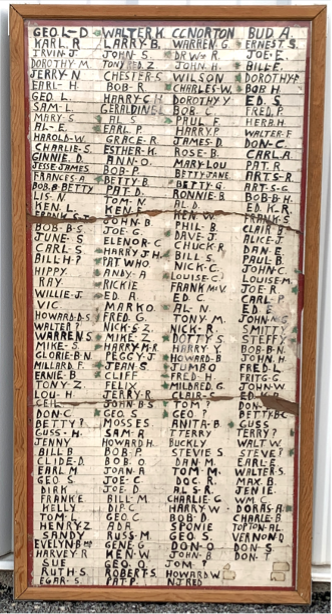
In late 1948 the Penn Street Group moved to South 7th Street (second and third floors). They met twice a week. The meeting place was adjacent to the railroad tracks, between Franklin and Penn Street. Many times hobos were found sleeping in the doorway. This building had no fire escape, so the group decided to acquire better facilities.
By 1947 or early 1948, the first woman came into A.A. in the Reading area. Women came in sporadically until the move to North Sixth Street.
In 1953 the group moved to 26 North Sixth Street (3rd floor), and in 1981, the group is still meeting at this location. The group met on Tuesday and Friday. It is interesting to note that on the first floor there was a bar, on the second floor a loan office and on the third floor, A.A. Some would say it took “49 steps” to get to the top. The Court House was directly across the street from the A.A. meeting room. Because rental costs were higher than before, the group decided to pay dues of 50 cents a week in addition to the collection. A member had to be sober three months before receiving a key to the door.
Several A.A. members objected to the club idea and started another group at 1000 Green Street. This group didn’t last very long and eventually returned to the 6th Street Group. For a short time, however, there was N. 6th Street meeting twice a week and 10th & Green Streets meeting once a week.
In 1953, the founder of the rehabilitation facility, Chit Chat Farms, came to Reading from the Midwest. He became sober through St. Paul-Minneapolis AA which believed strongly in discussing the 12 Steps at meetings and using the squad system in the home group. The squad system is to divide an AA group into smaller groups for better discussion of the 12 Steps. Since he had been an active AA member in St. Paul, he tried to encourage Reading AA members to talk more about the 12 Steps and not as much about their “Bottle and Binge” stories. AA members who discussed the 12 Steps at meetings also tried to get the group to adopt the squad system. This appeared to be the straw that broke the camel’s back. The original 6th Street members objected to these new ideas.
The “midwest influence” members started holding step meetings in homes in Wyomissing Hills, Womelsdorf and Temple. They started weekly AA meetings at the Berks County Jail and at Wernersville State Hospital. The institutional meetings continued to exist for over 17 years. By early 1956, these members broke away from the 6th Street Group and started a group at 5th and Court Streets (Christ Episcopal Church).
In the 1940’s and 50’s and early 60’s, there was a lack of community resources for the alcoholic. Welfare was unavailable or at least difficult to get. In an effort to carry the message and to help others, as well as themselves stay sober, many AA members opened their homes to an alcoholic who needed a place to stay. The wives were an integral part of AA. They gave needed support to their spouses, other AA members and to those still struggling to get sober. Although these women sacrificed much, they found it very rewarding. With the forbearance of not only the wife, but also the whole family, these wives fed and loved many an alcoholic. Also, since hospitals wouldn’t admit alcoholics, wives, as well as AA members, sat up all night with an alcoholic shaking out a drunk. In these homes and apartments many an unstructured meeting took place.
In 1966, a couple of AA members rented an apartment at 3rd and Spring Streets, to help the “down and out” alcoholic. After 6 months it became apparent that larger quarters were needed. A three-story apartment type building in the 500 block of Franklin Street was then rented. The landlord rented the building rent free for the first year under the condition that the building be renovated. About this time the Court Street Group left Christ Episcopal Church and formed a group at the Franklin Street building. Meetings were held seven nights a week on the first floor and the second and third floors became a halfway house. The group members and the residents of the halfway house did all the renovating. This was an ideal location because across the street was the office of one of the few doctors in the Reading area who was sympathetic to alcoholics, Dr. Peter Stelmach.
During 1957-58, in order to bridge the gap caused by the “split” between the 6th Street and the “Midwest” group members, AA meetings were exchanged once a month between 6th Street and Franklin Street.
There now grew a need for a place larger than the Franklin Street halfway house. The wife of the man from St. Paul suggested finding a place in the country to be a home and halfway house. Many of the Franklin Street residents lived here at no charge. AA meetings were held daily and the meetings were opened to all AA members. Within a couple of years this halfway house in Wernersville, evolved into a treatment center for alcoholics.
In 1959 a meeting was started at the Lutheran Church on Penn Avenue in West Reading. This meeting lasted for approximately 1 to 2 years. Because the owner of the Franklin Street apartment would not renew the rental option and the opening of Chit Cat Farms, the Franklin Street halfway house closed in 1959-60. The Franklin Street Group moved in 1960 to the YMCA for three weeks and then to the basement of the YMCA. The group continued to exist until 1968 by which time the meetings had dwindled to only 1 or 2 people. Some members started meeting at 6th Street on Monday nights and eventually were absorbed into the North 6th Street Group.
In 1961-62, the Wednesday Morning Group was started in a room at the NCA office on North Fifth Street. This group stayed at 5th Street for a number of years. After some problems between NCA and the AA members regarding the traditions, the group voted to move to 6th Street on Wednesday morning. The group stayed at 6th Street for about 5 years and then moved back to N. 5th Street, approximately four years ago.
In approximately 1962, the Wyomissing Group (Atonement Lutheran Church) was formed. This eventually became a very large group of 50 to 60 people. They met on Thursday evenings and because of their size would have as many as three different meetings going on at the same time. It was an open meeting. A few wives took things out of the meeting. Many members were upset and some decided to have an all men’s meeting at a member’s home. For some time it wasn’t unusual to go to the Wyomissing Meeting and find the doors locked. But the Wyomissing Group is again stable, active and healthy and has been so for a good number of years.
In 1968, Wilshire Fellowship Group was started. Springview Group was formed in 1969-70. Both of these groups are still active and healthy. Since 1970, Reading area AA has grown to approximately 25 groups, with a number of these groups meeting two or more times a week.
Some of the oldtimers feel that AA groups started multiplying after so many churches opened their doors. Although the growth is very positive, some feel the move to holding meetings in churches weakened many members feeling of responsibility to the group, financially and in the weekly functioning. They are not implying that before, members were bubbling all over to be active and responsible – but that they had to be responsible. Members had to (1) meet the mortgage or rent; (2) take care of their meeting place since there were no janitors to do so; (3) take care of all newcomers since there wasn’t anywhere else they could go.
Reading area AA thanks those “oldtimers” who have shared their thoughts, experience, strength, and hope with us. This history was written at the request of the Archives Committee at GSO. Anyone interested in writing their own home group’s history, please forward it to the Reading Intergroup, P.O. Box 184, Shillington, Pa. 19607.
Unknown author
2025 notes:
- WCTU = Women’s Christian Temperance Union
- NCA = National Council on Alcoholism
- Chit Chat Farms renamed to Caron Foundation in 1982
Interested in more AA History from the Reading-Berks Area? View more of our digitalized archive collection through past newspaper clippings and the histories of some of the area’s homegroups. Have a question or a bit of AA’s history in the RBI area that we don’t? Reach out to our archives chairperson at archives@readingberksintergroup.org.